Kuaiya Smart Route Engine: How It Matches the Best Node
On August 19, 2026, Kuaiya publicly detailed the technology behind its smart route-selection engine. Through real-time probing, multi-dimensional scoring and dynamic scheduling, the engine turns manual node switching into a fully automated process — a key pillar of v4.2's improved stability.
For years, accelerator users have faced one major pain point: node latency and throughput fluctuate with time, carrier and region. A node that performs well during the day can become congested at peak evening hours. Kuaiya's smart route engine was built precisely for this — replacing static node lists with decisions grounded in live data.
Real-Time Probing: Turning Latency into Data
The engine's first step is probing. Before a connection is established, the client sends lightweight probe packets to candidate nodes, collecting round-trip time (RTT), jitter and packet loss. Probes are kept tiny to avoid any perceptible impact on user bandwidth.
Raw readings are then smoothed through a sliding window. The team introduced a weighted-average mechanism that gives recent results higher weight, filtering out occasional spikes to produce stable figures that match real-world experience.
Multi-Dimensional Scoring and Dynamic Scheduling
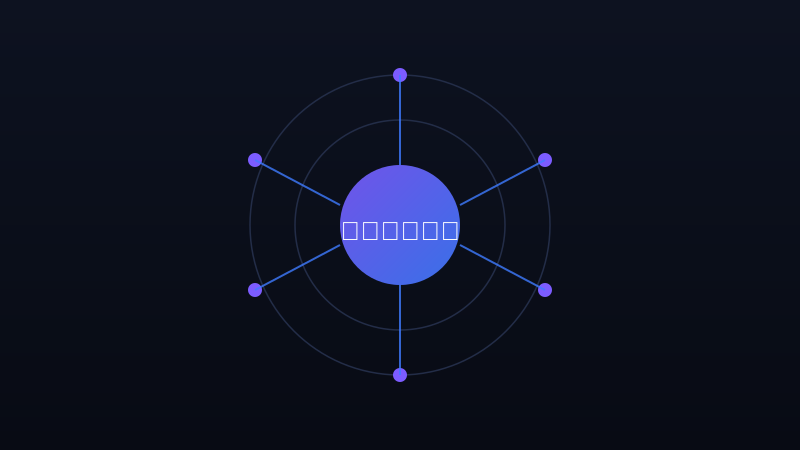
Latency alone is not enough. The engine combines latency, historical loss, node load and carrier interoperability into a composite score for each node. The lowest-latency node is not always optimal — if it is under heavy load, its actual throughput may lag behind a slightly higher-latency but idle route.
After scoring, the scheduler narrows candidates based on the user's location and destination. During connection, the client tries several top-scored nodes in parallel and locks onto the first genuinely usable one, completing the whole process in a few hundred milliseconds.
Data and Real-World Feedback
According to Kuaiya's internal tests, smart selection cut cross-region connection time by about 32% and reduced average peak-hour packet loss by roughly 41%. These figures come from 30 days of large-scale sampling across 200+ nodes, covering multiple carriers and regions.
One long-time cross-border e-commerce user reported that he previously tried five or six nodes manually each day; after switching to Kuaiya, connections "basically no longer need intervention," with visibly faster store backends at peak times.
Industry-wide, competition is shifting from "who has more nodes" to "who uses nodes smarter." Kuaiya's engine means the connection experience no longer depends on user expertise, but on continuously evolving algorithms. The team says predictive models based on historical data are next, letting the engine lock in the best route before the user even clicks connect.
Comments (5)
Used to switch nodes manually every day; now it just works with transparent latency data.
The auto-selection really cuts connection time. Impressive engineering detail.
Barely any dropouts at peak hours now; packet loss is much lower.
Multi-dimensional scoring is the right call — pure latency can mislead.
Clear technical writing that even non-engineers can follow.